Beyond Traditional Search: Why Ahrefs and Semrush Data Misses AI Citations
Traditional SEO tools like Ahrefs and Semrush measure how humans find links. They do not measure how Large Language Models (LLMs) synthesize your brand's data into a single answer. As of April 29, 2026, the technical gap between "ranking" and "citation" has widened into a chasm that legacy platforms cannot bridge with simple SERP scraping.
While Ahrefs and Semrush have introduced features like Brand Radar and the AI Toolkit to track Google AI Overviews, these features are fundamentally limited to the search engine results page (SERP). They miss the massive volume of brand discovery happening inside direct conversational interfaces like ChatGPT, Claude, and Perplexity, which now handle billions of queries monthly without ever appearing on a traditional search results page.
The Technical Gap: Indexed Pages vs. Cited Responses
In traditional SEO, the goal is to get a URL into the top 10 results. In Generative Engine Optimization (GEO), the goal is to get your brand's facts into the LLM’s context window. These are different technical processes.
- Retrieval vs. Ranking: Google ranks pages based on backlinks and user signals. LLMs retrieve information based on semantic proximity and factual density. Recent 2026 benchmarks show that 80% of sources cited by LLMs do not rank in Google’s top 100 organic results. If you are only tracking your Ahrefs rank, you are invisible to the systems processing 37% of all consumer research queries.
- Synthesis vs. Selection: A search engine selects a list of links. An LLM synthesizes a narrative. When ChatGPT (which as of April 2026 has surpassed 900 million weekly active users) answers a prompt about "best enterprise CRM for mid-market manufacturing," it isn't just looking for a high-ranking page. It is looking for a reliable entity definition it can trust to represent as a fact.
- The Zero-Click Reality: Google AI Overviews now appear in approximately 55% of all US searches. This has pushed the zero-click rate to over 60% for informational queries. Traditional tools track "clicks" as the primary success metric, but in a GEO-first environment, the primary metric is Citation Share—the frequency with which your brand is named as the authoritative source within the AI's generated response.
Why Keyword Volume is a Lagging Indicator
Legacy tools rely on keyword volume to prioritize content. This is a lagging indicator that fails in the era of agentic search. AI systems like Perplexity and Google’s AI Mode (which currently serves 75 million daily active users) do not wait for a keyword to trend. They respond to Prompt Intent.
- Keyword-based strategy: Target "best cloud security software" because it has 10k monthly searches.
- Intent-based GEO strategy: Optimize for the prompt "Compare cloud security providers for HIPAA compliance in multi-cloud environments."
Olwen identifies these high-intent prompts before they show up as high-volume keywords in Semrush. By monitoring AI crawler visits—specifically GPTBot, OAI-SearchBot, and Google-Extended—via your CDN workflows, Olwen identifies which specific sections of your site are being ingested for future model training or RAG (Retrieval-Augmented Generation) responses.
Comparing Traditional SERP Tracking with Olwen
| Feature | Ahrefs / Semrush | Olwen |
|---|---|---|
| Primary Surface | Google SERP (Blue Links) | LLM Responses (ChatGPT, Claude, Perplexity, Gemini) |
| Data Source | Scraped Search Results | API-level LLM Monitoring + CDN Log Analysis |
| Metric | Domain Authority / Keyword Rank | Citation Reliability Score / Share of Citation |
| Technical Fixes | Meta Tags / Backlink Building | Schema Injection / Dataset Markup / Repo-to-CMS Automation |
| Crawler Tracking | General Bot Detection | Specific AI Agent Identification (GPTBot, PerplexityBot) |
| Conversion Focus | Click-Through Rate (CTR) | Lead-to-Opportunity Ratio from AI-referred traffic |
Replacing 'Domain Authority' with 'Citation Reliability'
Domain Authority (DA) is a proxy for how many people link to you. It is increasingly irrelevant to LLMs. In 2026, AI systems prioritize Citation Reliability. This score is calculated based on three technical factors that Olwen tracks:
- Entity Consistency: Does your brand describe its capabilities the same way across your site, your GitHub repo, and your documentation? LLMs penalize brands with conflicting entity definitions.
- Factual Density: Does your content provide specific, extractable data points? Research from early 2026 shows that pages with benchmark data and pricing comparisons are cited 2.8x more often than generic marketing copy.
- Source Recency: LLMs weight recent content more heavily. A media placement from last week carries more weight in a generative response than a high-DA backlink from three years ago.
Olwen’s Citation Reliability Score tells you exactly how likely an LLM is to trust your site as a primary source. If your score is low, Olwen generates the specific technical fixes—such as Nested Article Markup or Dataset Schema—needed to improve it.
Technical Site Fixes for AI Summary Engines
To win in GEO, you must move beyond basic metadata. You need to structure your site as a database for AI agents.
1. Implement Nested Article and Dataset Schema
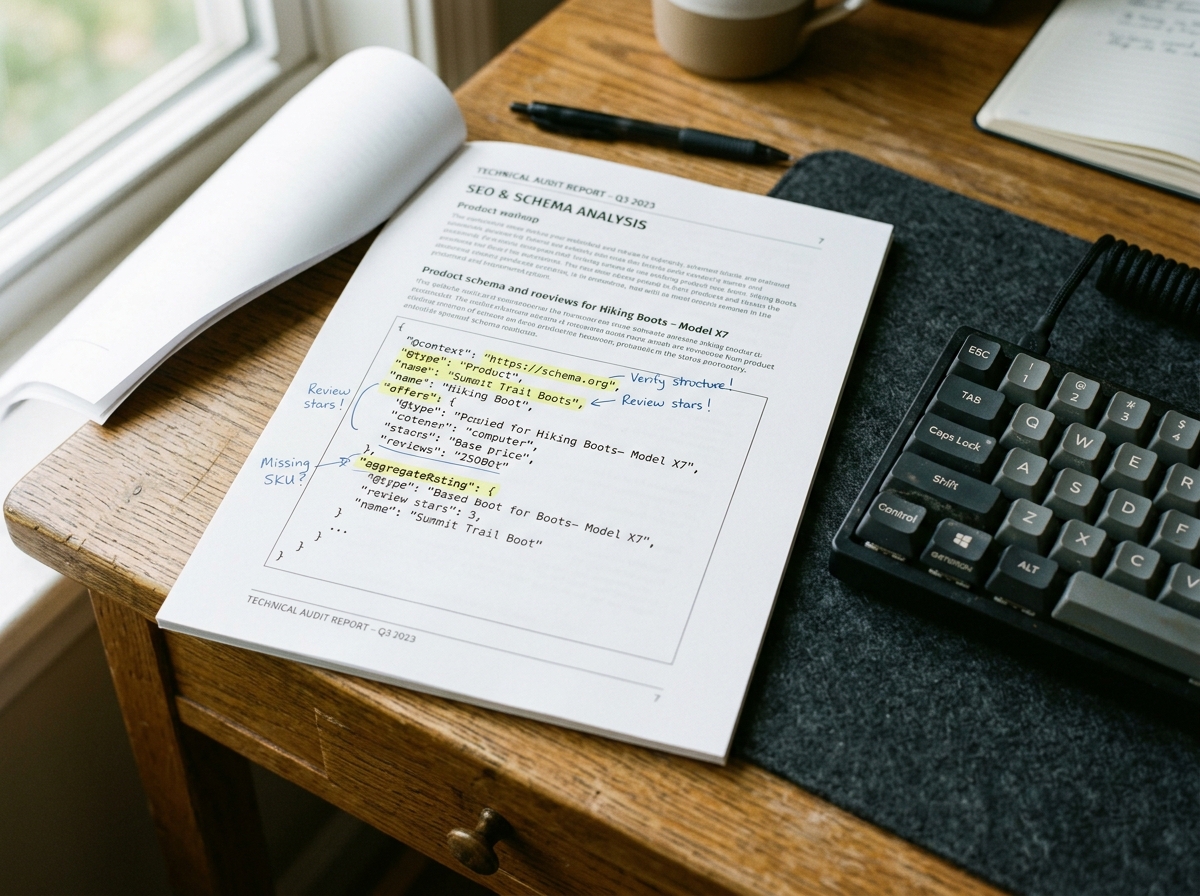
Standard Article schema is no longer sufficient. To be cited in complex comparisons, use Nested Article markup to define specific sub-entities within a page. If you publish research, use Dataset Schema to make your statistics "grab-able" for AI models looking for evidence to support a claim.
2. Connect Repo and CMS for Automated Publishing
GEO requires a faster feedback loop than traditional SEO. When Olwen identifies a competitor winning a citation for a key prompt, you cannot wait for a monthly content cycle. Olwen connects directly to your GitHub or GitLab repo and your CMS (Contentful, Sanity, WordPress) to ship schema updates and FAQ sections in real-time. This ensures your site is always optimized for the latest model weights and retrieval patterns.
3. Track AI Crawler Visits via CDN Workflows
By connecting to your CDN (Cloudflare, Akamai, Vercel), Olwen monitors the frequency and depth of AI crawler visits. If GPTBot is hitting your documentation but ignoring your product pages, you have a structural issue preventing your product from being cited in "how-to" queries. Olwen identifies these gaps and suggests internal linking fixes to guide the crawlers to high-value conversion pages.
The GEO Workflow: From Monitor to Publish
Stop treating AI visibility as a side project. Implement a chronological workflow that treats GEO as a core engineering lever.
- Monitor: Use Olwen to track where your brand is mentioned in ChatGPT, Gemini, and Perplexity. Identify the "Missing Prompts" where competitors are being cited instead of you.
- Analyze: Compare your Citation Reliability Score against the cited competitors. Determine if the gap is due to factual density, schema errors, or lack of recent data.
- Generate Fixes: Use Olwen to generate AI-optimized FAQ sections, structured data blocks, and technical site fixes. These are not just "better content"; they are technical structures designed for LLM ingestion.
- Publish: Automate the deployment of these fixes via your connected repo and CMS. Ensure that every time an AI model refreshes its index or performs a real-time web search, it finds your most current, structured, and authoritative data.
- Verify: Track the impact on your Share of Citation. As of 2026, brands using this automated GEO workflow report a 30-40% increase in AI citations within 60 days.
The High-Value Conversion of AI Traffic
While traditional organic traffic volume is declining, the quality of AI-referred traffic is significantly higher. Data from Q1 2026 indicates that AI search traffic converts at a rate 4.4x higher than traditional organic search. This is because the user has already had a multi-turn conversation with an AI assistant; by the time they click your citation, they are pre-qualified and deep in the consideration phase.
If you are still optimizing for the "Ten Blue Links," you are optimizing for a shrinking market. Ahrefs and Semrush will tell you how you performed in the old world. Olwen tells you how to win in the new one.

Next Steps for Growth Leads
Connect your Google Search Console and your CDN to Olwen to begin tracking your baseline Citation Reliability Score. Identify the top 50 prompts driving research in your category and audit your current schema coverage against those specific intents. Shift your content production from high-volume keyword targeting to high-density factual reporting. Automate the publishing of these updates through your CMS to ensure your brand remains the primary citation in an increasingly zero-click environment.