Automating AI Visibility: Connecting Your Repo to CMS for Schema Injection
AI systems like ChatGPT Search, Perplexity, and Google AI Overviews now absorb 15-20% of informational query volume as of April 2026. For product-led companies, the risk is no longer just a drop in organic clicks; it is being omitted from the "consideration set" generated by frontier models like GPT-5.4 Thinking and Claude 4.6 Sonnet. When these systems crawl your site, they don't just look for keywords; they extract entities. If your structured data is stale or missing, the AI's internal representation of your brand becomes fragmented, leading to hallucinations or competitor-first recommendations.
Traditional SEO workflows—where an editor manually updates a CMS field and a developer occasionally audits schema—are too slow for the generative era. You need a closed-loop system that connects your technical repository (the source of truth for product specs and documentation) directly to your CMS via an optimization layer like Olwen. This guide details the technical workflow for automating schema injection and metadata management to ensure maximum AI visibility.
Link Technical Repositories for Real-Time Monitoring
Your code repository is the earliest point of truth for brand changes. When a developer updates a product feature in a JSON config or changes a pricing tier in a markdown file, that data should immediately trigger a GEO (Generative Engine Optimization) update.
- Connect GitHub/GitLab to Olwen: Use the Olwen integration to monitor specific directories (e.g.,
/docs,/config,/pricing). Olwen tracks diffs in these files to identify new entities or modified attributes. - Define Entity Mapping: Map repository variables to Schema.org types. For example, a
version_numberin yourpackage.jsonshould map to thesoftwareVersionproperty of aSoftwareApplicationschema. - Set Up Webhook Triggers: Configure your CI/CD pipeline to ping Olwen on every successful merge to the main branch. This ensures that the AI-optimized version of your content is generated the moment the code is ready for production.
By monitoring the repo, you eliminate the lag between product shipping and search visibility. AI crawlers like OAI-SearchBot and ClaudeBot prioritize fresh, structured data; a repo-linked workflow ensures they find it on their next pass.

Configure Automated Schema Generation
As of March 2026, Schema.org version 30.0 is the current standard, introducing critical updates like the Credential class and EU Digital Product Passport (DPP) support. Manual JSON-LD creation is prone to syntax errors that cause AI ingestion failure. Olwen automates this by generating valid, high-density JSON-LD based on your repo data.
Product and SoftwareApplication Schema
For SaaS and hardware founders, the SoftwareApplication and Product types are the most influential. Olwen injects specific properties that frontier models use for comparison tables:
offers: Includeprice,priceCurrency, andavailability. AI systems use this to answer "What is the cheapest [Category] tool?"featureList: Use specific technical nouns. Instead of "Easy to use," use "REST API," "OAuth 2.0," or "Edge-side rendering."operatingSystem: Essential for developer tools to appear in "Best [OS] apps" queries.
FAQ and HowTo Schema
Generative engines rely heavily on FAQPage and HowTo schema to build their response logic. Olwen extracts questions from your documentation and formats them into structured blocks. This increases the likelihood of your brand being cited as the primary source in a "How do I..." AI response.
| Schema Type | Key Properties for AI | Impact on GEO |
|---|---|---|
| SoftwareApplication | applicationCategory, featureList, releaseNotes | High: Powers comparison and "Best of" lists. |
| FAQPage | mainEntity (Question/Answer pairs) | High: Direct source for RAG (Retrieval-Augmented Generation). |
| Organization | sameAs, logo, foundingDate | Medium: Establishes brand authority and entity trust. |
| Product | aggregateRating, review, brand | High: Drives "Top rated" and "Recommended" citations. |
Sync Metadata Updates via API Workflows
Once Olwen generates the optimized schema and metadata, it must be pushed to your CMS. This removes the need for manual entry by marketing teams.
- Configure CMS API Access: Connect Olwen to your headless CMS (e.g., Contentful, Strapi, Sanity) or traditional platform (WordPress, Shopify) using API keys with write permissions for metadata fields.
- Automate Field Mapping: Map Olwen’s output (e.g.,
generated_json_ld,optimized_meta_description) to the corresponding fields in your CMS content models. - Enable Partial Updates: Use PATCH requests to update only the SEO/GEO fields without touching the body content. This prevents accidental overwrites of editorial work while ensuring the underlying structure is always current.
This sync ensures that your live site always presents the most "crawlable" version of itself to AI agents. When GPT-5.4 or Gemini 3.1 Pro visits your page, they find a perfectly structured JSON-LD block that matches the latest technical specs from your repo.
Validate Schema Health Against AI Ingestion Requirements
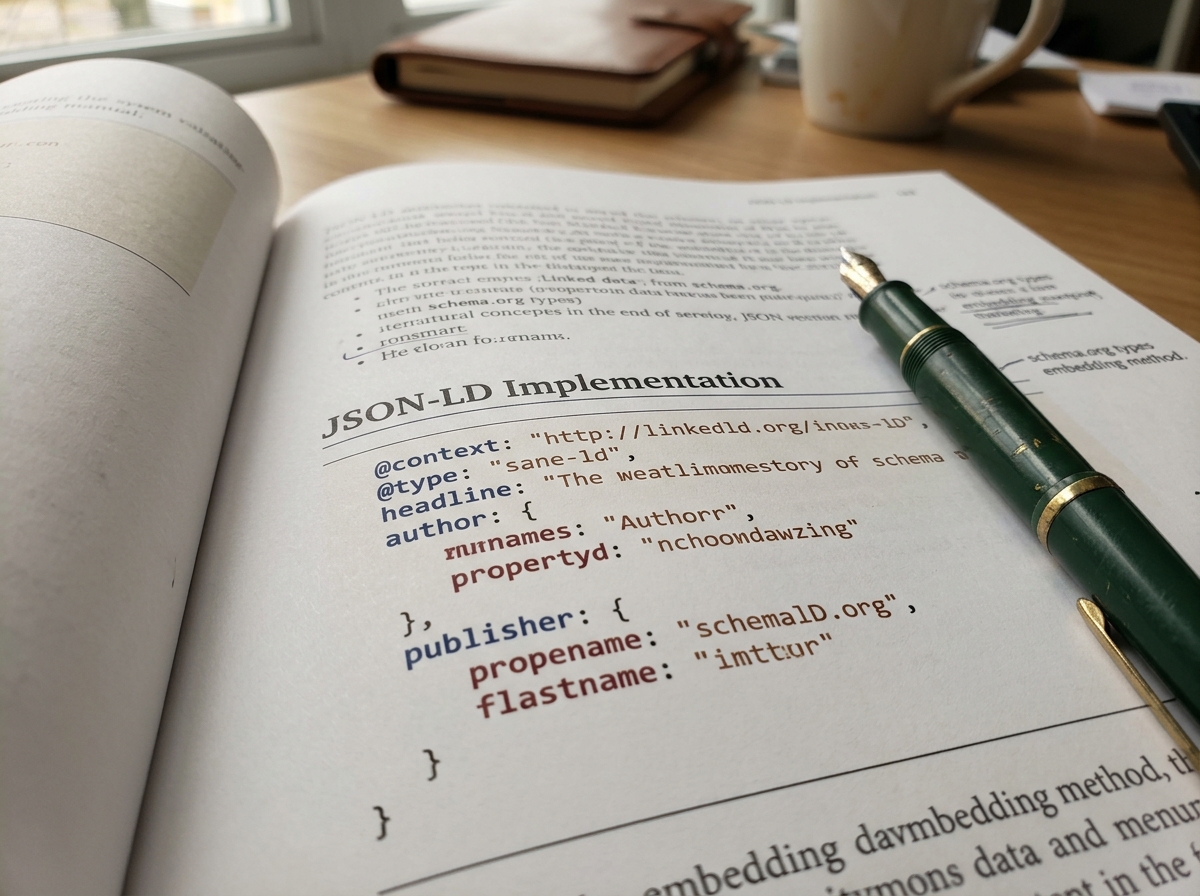
Validating for Google's Rich Results Test is no longer sufficient. AI systems have stricter requirements for entity resolution. Olwen provides a validation layer that checks for "Entity Completeness"—ensuring that every Organization is linked to its social profiles via sameAs and every Product has a clearly defined @id for cross-referencing.
- Check for Broken References: Ensure that internal
@idlinks between different schema blocks (e.g., anArticlepointing to anAuthorentity) are resolvable. - Verify Against AI Crawler Specs: Different bots have different preferences. For example, PerplexityBot favors dense factual data, while OAI-SearchBot (OpenAI) looks for clear attribution and source links. Olwen audits your schema against these specific bot behaviors.
- Monitor for Manual Actions: AI-driven search engines are increasingly penalizing "hidden" schema that doesn't match the visible page content. Olwen’s validation engine flags discrepancies between your JSON-LD and the rendered HTML to prevent de-indexing.
Deploy Updates Without Manual Intervention
The final step is the automated deployment of these fixes. By connecting Olwen to your CDN (Cloudflare, Vercel, Netlify), you can inject schema and metadata at the edge. This is particularly useful for legacy systems where the CMS is difficult to modify.
- Edge Injection: Use Cloudflare Workers or Vercel Edge Functions to intercept requests and inject the Olwen-generated JSON-LD into the
<head>of the HTML before it reaches the user (or the crawler). - Zero-Touch Publishing: Once the workflow is configured, any change in the repo automatically flows through Olwen, updates the CMS (or edge cache), and becomes visible to AI crawlers within seconds.
- Version Control for SEO: Because the updates are triggered by repo changes, you have a full git history of your GEO improvements. If an AI system starts misrepresenting your brand, you can trace the exact change in your structured data that caused the shift.
Track AI Crawler Visits via CDN Workflows
You cannot optimize what you do not measure. Traditional analytics (Google Analytics 4) are blind to many AI crawler visits because these bots do not execute JavaScript. You must track them at the server or CDN level.
- Identify AI User Agents: Monitor logs for
GPTBot,ChatGPT-User,OAI-SearchBot,ClaudeBot,PerplexityBot, andApplebot-Extended. - Analyze Crawl Frequency: A sudden increase in
ClaudeBotactivity often precedes a brand being cited more frequently in Claude 4.6 responses. Olwen tracks these correlations to show you which technical changes are driving AI interest. - Monitor "Crawl-to-Referral" Ratios: As of April 2026, the average ratio for ClaudeBot is 13,528:1 (crawls to human visits). While the referral traffic is low, the visibility in the AI's training set is the real KPI. Olwen provides a dashboard to track this "Generative Share of Voice."
Improve Metadata and Structured Data Consistency
AI systems are highly sensitive to contradictions. If your meta description says your product is "Free for startups" but your PriceSpecification schema says "$49/month," the AI will likely flag the data as unreliable and omit it from search results.
Olwen acts as a consistency engine. It cross-references your meta tags, Open Graph data, and JSON-LD to ensure a unified brand narrative. This "Semantic Harmony" is a primary ranking factor in GEO. When your technical repo, CMS, and metadata are perfectly aligned, you create a high-trust signal that frontier models prioritize for citations.
To maintain this consistency, audit your Organization schema monthly. Ensure that your legalName, address, and contactPoint match exactly across all platforms, including third-party review sites and Wikipedia. AI systems use these identifiers to "stitch" together information about your brand from multiple sources. A single discrepancy in your address or founding date can lead to the creation of duplicate, conflicting entities in the AI's knowledge graph.
Turn Competitor Wins into Schema Updates
Olwen monitors where your competitors are winning in AI responses. If a competitor is cited for a specific feature you also offer, Olwen identifies the missing schema properties on your site that prevented the AI from recognizing your capability.
- Competitor Gap Analysis: Olwen queries ChatGPT and Perplexity for your target keywords and identifies which competitors are cited.
- Schema Reverse-Engineering: The system analyzes the structured data of the winning competitors to find the specific attributes (e.g.,
isRelatedTo,award,certification) they are using. - Automated Fix Generation: Olwen generates the necessary schema updates for your site to close the gap and pushes them through your repo-to-CMS workflow.
This proactive approach ensures you are not just reacting to the AI landscape but actively shaping how your brand is perceived and recommended by the next generation of search engines.
Connect your GitHub repository to Olwen today to begin monitoring your brand's AI visibility and automating the injection of high-density structured data across your CMS and CDN workflows.